
01 · Opening Insight · Future Economy
Trade isn't breaking.
It's getting fenced in.
Who gets access to the next version of globalization?
Global trade is not collapsing. It is being rerouted through trusted corridors, controlled gateways, chokepoints, compliance filters, and new rules of access.
Nav Chart · 004-X
Of Global Trade Passes Through One Corridor
"That is not a route. It is a gate."
Annual Traffic Log
Recorded transit through the Strait of Malacca · 2025 — the world's busiest maritime trade route.
Through the Strait
"Trade is not breaking. It is being fenced. Goods, capital, companies, and talent still move — but movement depends on whether you are inside the right corridor."
The new map of globalization is not flat. It is gated. Access depends on trust, compliance, geography, political alignment, and gateway position.
Four Pathways
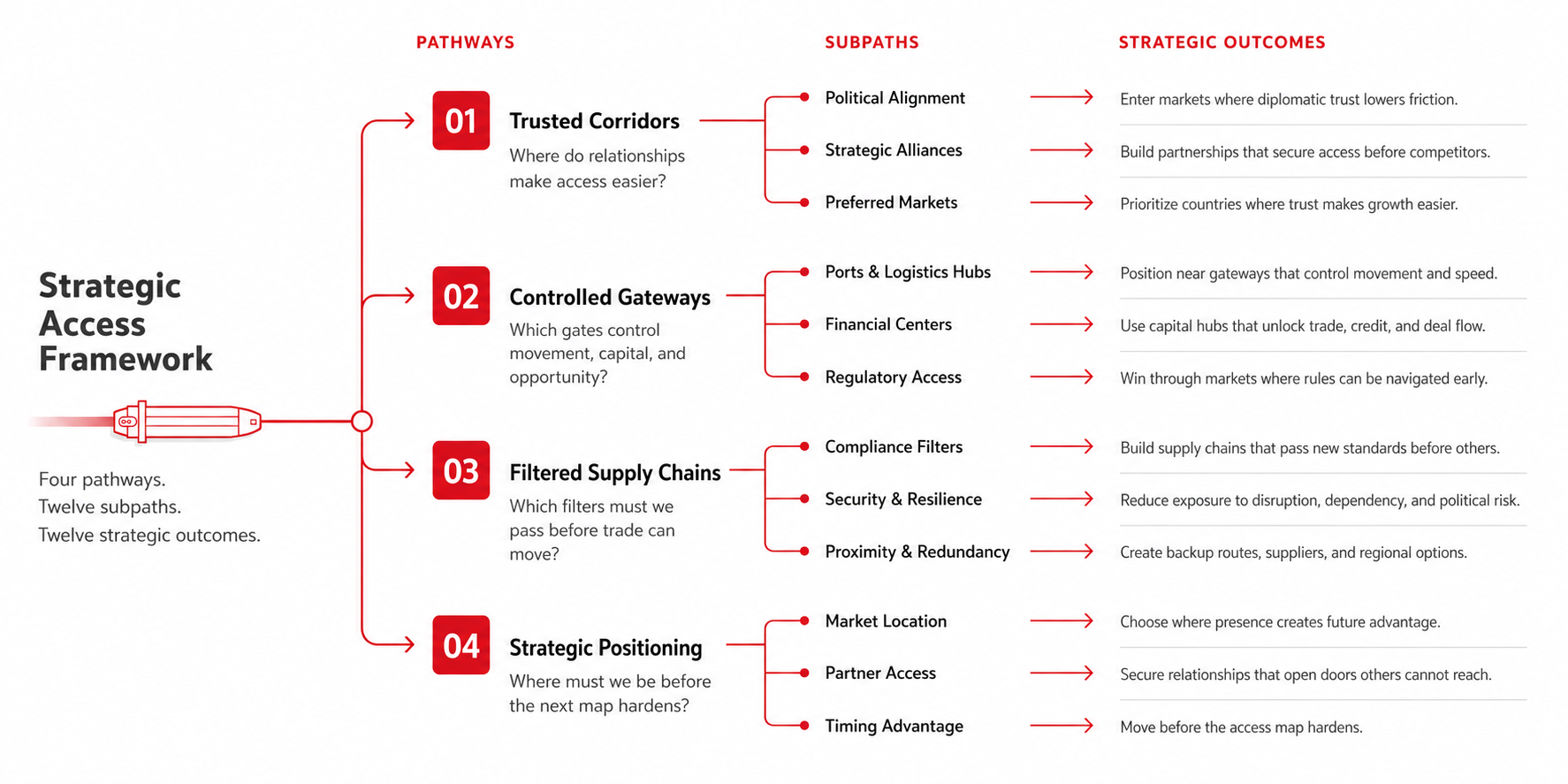
The next version of globalization is being shaped by four pathways.
TRUSTED CORRIDORS
Trade, capital, and companies move through strategic alliances, preferred markets, and politically safer routes.
CONTROLLED GATEWAYS
Ports, financial centers, digital platforms, and regulatory bodies decide who gets access, speed, and trust.
FILTERED SUPPLY CHAINS
Supply chains are redesigned around resilience, compliance, proximity, and strategic control.
STRATEGIC POSITIONING
Winners are not the biggest — they are best positioned inside the right corridors and trusted by the right systems.
Around 20% of global oil and LNG also moves through the Strait of Hormuz.
Strategic Pathways
The Strategic Map of Key Outcomes
Four pathways. Twelve subpaths. Twelve strategic outcomes.
The Leadership Question
The question has changed.
Where can we sell?
Access
Where can we still access?
Trust
Where can we be trusted?
Gateways
Where are the new gateways?
Corridors
Which corridors are opening — or closing?
Positioning
Where do we position before the map hardens?
Core Conclusion
Globalization is not dead. It is becoming gated.
The next advantage will belong to leaders who understand the new access map before everyone else is forced to.
Need this thinking in your boardroom, strategy session, or investment mandate?
Bring this insight into the room — where the next access map gets drawn before it hardens.