How the role is evolving into the Growth Scientist — and what skills, mindset and systems you need to build modern growth capability in the age of AI
Most advice on how to become a growth hacker is starting to show its age. Learn analytics. Master acquisition. Understand SEO. Learn some code. Take a course. Build a tool stack. Run experiments. There is nothing fundamentally wrong with any of that; much of it remains useful. The problem is that it describes the growth hacker of yesterday more accurately than the growth practitioner we are going to need tomorrow.
AI is changing that equation quickly. One person can now research customers, interrogate large amounts of data, write code, generate campaign concepts, prototype products, automate workflows and test ideas at a speed that previously required several specialists. Capabilities that once created a genuine technical advantage are becoming easier to access, easier to combine and cheaper to deploy.
That creates an important paradox: the easier powerful tools become to access, the less those tools themselves differentiate you. The career question therefore changes. It is no longer enough to ask, What skills do I need to become a growth hacker? A more important question is emerging: What do I need to be able to see, understand, test and build when everyone around me has increasingly powerful tools too?
I believe that question points toward the next evolution of the profession. It does not mean abandoning growth hacking; growth hacking remains an important foundation. But it does mean expanding the idea beyond its original boundaries.
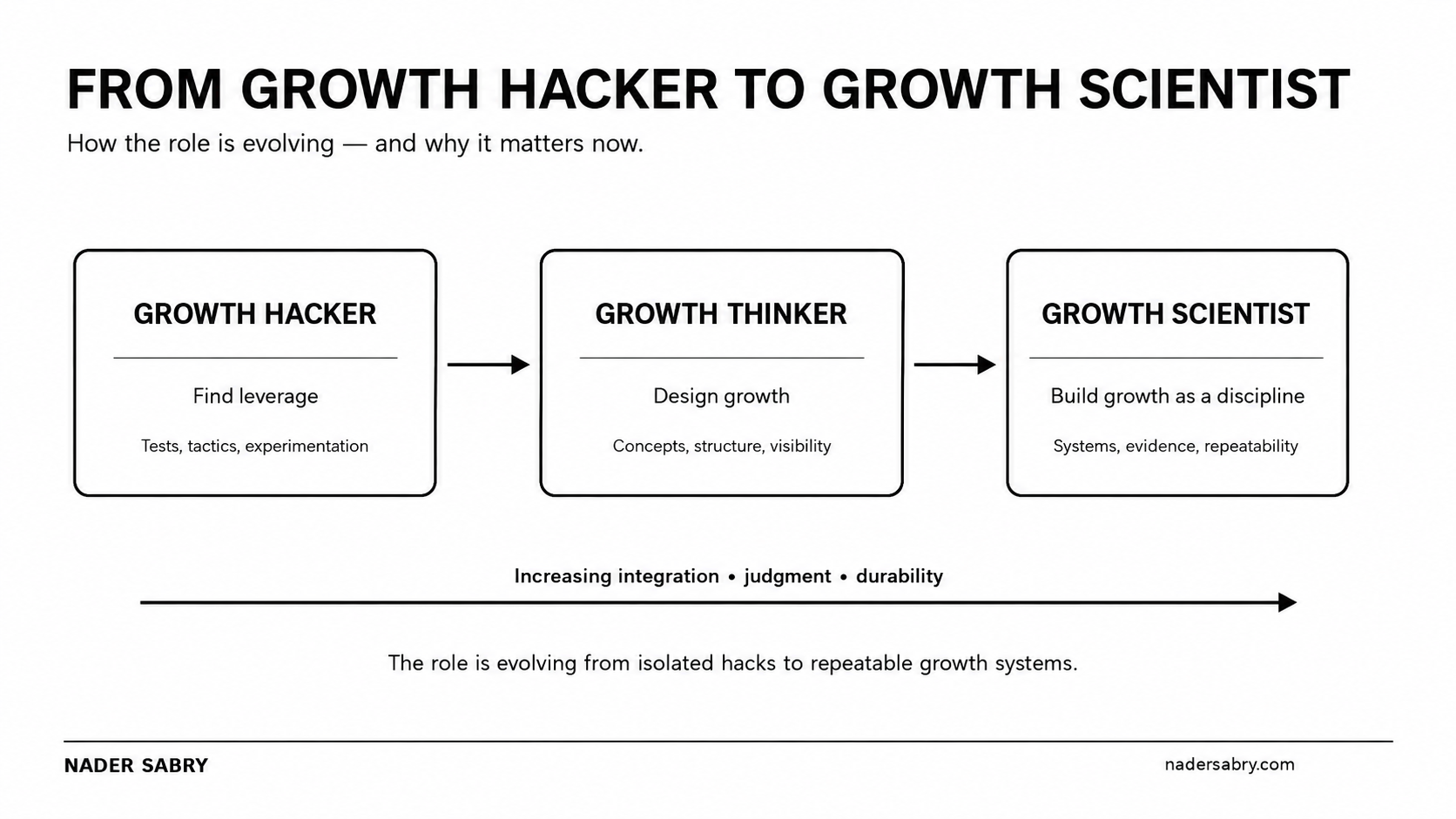
Growth Hacker → Growth Thinker → Growth Scientist
To understand why that evolution matters, we first need to get back to the underlying purpose of growth hacking itself.
What Does a Growth Hacker Actually Do?
Growth hacking is often defined by its tools: analytics, experimentation, digital channels, automation and technology. That description is understandable because those capabilities played an important role in the early growth-hacking movement, but it misses the underlying purpose of the discipline.
I define growth hacking simply:
Growth hacking is the systematic search for disproportionate growth.
I explore that definition and the wider discipline more deeply in What Is Growth Hacking?. The important point here is that growth hacking was never supposed to mean accumulating clever tricks, copying viral tactics or learning the latest software platform. It is fundamentally about finding leverage.
Growth Hacking Is About Leverage
Leverage appears when a relatively small change creates a materially larger change in the result. A small improvement to onboarding might materially increase retention. A change in pricing may improve the economics of an entire customer base. A partnership could create access to distribution that would otherwise take years to build. A technology change could remove a bottleneck the organization had simply learned to accept.
One of the best examples of this came from Microsoft's Bing. A relatively small change to how search ads were displayed had been considered low priority and sat untouched for months. When an engineer eventually tested it, the experiment showed a 12% increase in revenue, estimated at more than $100 million annually in the United States at the time. Harvard Business Review documented the case as an example of the surprising value that controlled experimentation can uncover.
The lesson is not the Bing tactic itself. Copying it would miss the point. The important lesson is that the value of the idea was not obvious from experience, hierarchy or opinion. Evidence exposed the leverage. That is what the growth practitioner should be learning to do.
The strongest opportunity is often not where the business first expects it to be. A company might believe it has a marketing problem because sales are falling, but the actual constraint could sit inside the product, pricing, customer experience, distribution or even the business model. The job of the growth practitioner is not to force every problem through the tools they already know. It is to follow the evidence until they understand where the real leverage sits.
A practitioner who knows twenty acquisition tactics may therefore be far less valuable than someone who correctly recognizes that acquisition is not the problem in the first place.
Where Growth Can Actually Be Found
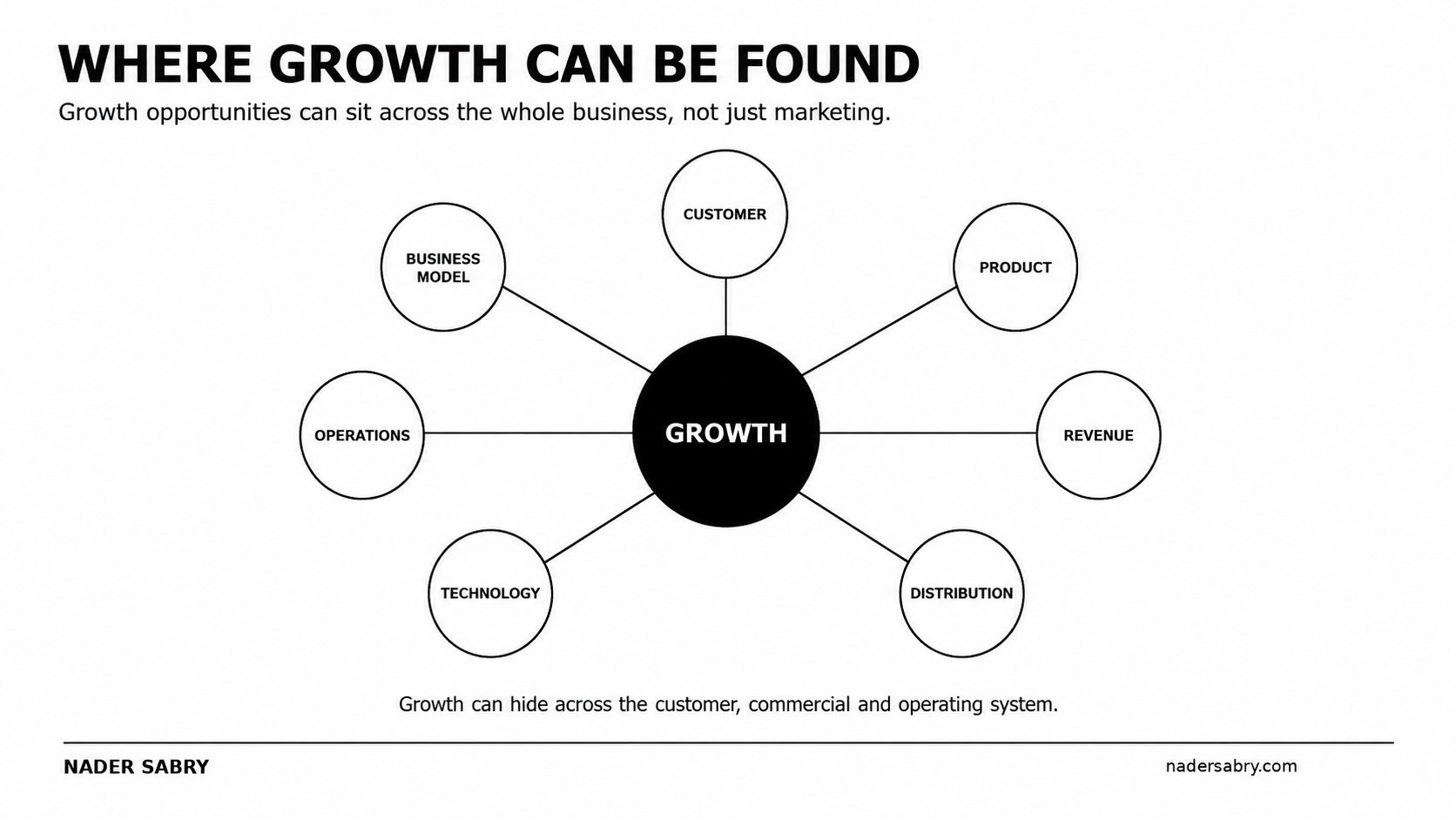
Once you think about growth this way, it becomes obvious that the opportunity does not necessarily belong to marketing. Growth might be hiding in:
Marketing — acquisition, conversion, demand or positioning.
Product — activation, usage, features or experience.
Commercial — pricing, monetization, retention or expansion.
Distribution — channels, partnerships or access to market.
Technology — AI, automation, data or capabilities that were previously impossible.
Operations — speed, friction, process or capacity.
Business model — changing how the organization creates or captures value.
This is why I keep coming back to a simple principle: growth does not belong to a department. Growth is a business outcome. If growth can be hiding almost anywhere inside an organization, the practitioner cannot become excellent in one channel and assume every meaningful growth problem will eventually arrive there. They need enough breadth to follow the problem, enough depth to understand what they find and enough judgment to know when something genuinely matters.
Take a company complaining about lead generation. The obvious response is to improve marketing and create more leads. But what if lead volume is already strong and conversion is collapsing? What if conversion is healthy but customers disappear three months later? What if retention is excellent yet acquisition costs have made every new customer economically unattractive? Each situation might initially appear as “we need more growth,” yet each requires a completely different intervention.
The stronger the practitioner becomes, the less likely they are to accept the first explanation they are given. That is why the real career question becomes much more interesting than Which tools should I learn? It becomes: What kind of person becomes capable of systematically finding growth?
To answer that question, we need to understand how the role itself has evolved.
The Growth Hacker Has Evolved
The earliest growth hackers became associated with startups, digital marketing, technology and experimentation. They were valuable partly because they were willing to cross boundaries that traditional roles often protected. Marketing understood demand, developers understood technology, product teams understood the user, and analysts understood measurement. The growth hacker was often the person asking what might happen if those worlds were brought together around one growth objective.
Over time, that boundary-crossing became more important. Technology met marketing. Marketing met product. Product met data. Data met experimentation. Growth began touching pricing, customer experience, sales, operations and strategy. That expansion was not accidental. The underlying business problem had always been cross-functional; the profession simply began catching up with that reality.
My own work evolved through a similar sequence. Growth hacking taught me to search for leverage and challenge assumptions about where growth could come from. But finding an opportunity raised another problem: what do you actually do with it?
You can have a brilliant growth insight and still achieve nothing with it. Somebody has to translate that idea into something the organization can understand, challenge, test and execute. That problem led me to develop Growth Thinking, a methodology focused on moving a growth idea from something abstract into something that can be structured, visualized, prototyped, tested, improved and eventually scaled.
The relationship between the two became increasingly clear to me. Growth hacking helped find the opportunity; Growth Thinking helped design what happens next. One searches for leverage. The other creates a disciplined way of moving the idea toward action.
But even that leaves another problem unresolved. A successful growth idea can still be incredibly fragile.
Imagine one customer-success manager discovers how to dramatically reduce churn. The result looks fantastic, but when that person leaves, the improvement disappears. Was that a growth capability? Not yet.
Or imagine a pricing experiment increases revenue substantially. Everyone celebrates, the change is rolled out, and six months later performance begins deteriorating. Nobody can explain why the original intervention worked, which conditions made it successful or how the logic should adapt across different customers and markets. Again, the organization produced an outcome, but it did not necessarily build a capability.
That changes the question from Did it work? to How do we make what worked repeatable? Answering that requires more than an experiment. It may require process, technology, data, people, governance, ownership and partners. In other words, it requires a system.
Once you begin asking how an organization can repeatedly discover growth, systematically build around what it discovers and create something competitors cannot easily reproduce, you have moved beyond isolated growth hacks. You are entering what I describe as Growth Science: the broader discipline behind my work of making growth more visible, systematic, measurable and harder to copy.
The wider evolution of that thinking sits within my Growth Science philosophy. The important point here is that each stage solves a problem left open by the one before it. Growth hacking asks, Where is the leverage? Growth Thinking asks, How do we turn that opportunity into structured action? Growth Science asks, How do we repeatedly find growth, build the system that captures it and turn that system into an advantage?
And if Growth Science is the discipline, then it needs practitioners. In my Growth Science framework, I call that practitioner the Growth Scientist.
What Is a Growth Scientist?
Before introducing another professional title, there is a reasonable objection to address. Do we really need one? Why not simply keep calling this person a growth hacker?
My answer is that the unit of work has changed. A growth hacker is strongly associated with finding and testing opportunities. The Growth Scientist still needs that capability, but their responsibility is broader. They need to understand what caused the problem, whether the opportunity actually matters, what evidence should be trusted, how to test the intervention, how to reproduce the result and whether the resulting capability can eventually become a source of advantage.
So this is not simply a different label for the same job. The method has expanded.
A Growth Scientist is a practitioner who systematically finds growth, builds the systems that capture it, and turns what works into scalable, defensible advantage.
That means approaching growth differently. The Growth Scientist favors evidence over assumption, hypotheses over opinions, experiments over guesses, systems over one-offs, measurement over anecdotes and learning over activity. These are not slogans. They describe a way of working.
The Growth Scientist is therefore not somebody who merely knows a great deal about growth. They have to be able to apply that knowledge repeatedly to real problems, under uncertain conditions, and produce evidence that improves decision-making.
Why the Data Scientist Comparison Matters
The comparison with data science helps explain the concept. Organizations had data long before data science became a recognized discipline. They had analysts, spreadsheets, databases, reports and forecasts. What evolved was not the existence of data; it was the discipline surrounding how organizations combined methods, models, evidence and different areas of expertise to extract value from it.
Growth faces a similar challenge. Every organization wants growth, yet responsibility for creating it remains fragmented. Strategy owns one piece. Marketing owns another. Sales owns another. Product, finance, technology, innovation and operations all own parts too.
That creates an important structural problem: the organization may be searching for growth through departments even though the opportunity itself sits between them. The Growth Scientist begins somewhere else. They ask: What is actually preventing or enabling growth, regardless of where inside the organization the answer sits?
That is a much broader professional mandate. And it becomes especially important now because the nature of execution itself is changing.
From Growth Hacker to Growth Scientist
The shift from Growth Hacker to Growth Scientist matters because the environment in which growth happens has fundamentally changed.
When growth hacking first emerged, many of the capabilities that gave growth hackers an advantage were relatively scarce. Technical skills were less widespread. Analytics were harder to access. Experimentation infrastructure was less mature. Building products, automating processes and reaching customers digitally often required specialist knowledge and significant resources. A growth hacker who could combine technology, marketing, data and unconventional thinking therefore possessed an unusually valuable combination of capabilities.
That scarcity is changing. AI, automation, no-code platforms, accessible analytics and increasingly powerful digital tools are placing enormous execution power into the hands of individuals. Work that once required several specialists can increasingly be initiated by one person, while ideas can be researched, prototyped, analyzed and tested at a speed that would have been unrealistic during the earlier growth-hacking era.
The skills data points in the same direction. The World Economic Forum reports that AI and big data are among the fastest-growing skills, yet analytical thinking remains the most sought-after core skill among surveyed employers. Creative thinking, curiosity and lifelong learning are also expected to rise in importance. The signal is important: the future is not simply technical capability replacing human capability. It increasingly requires the two to work together. World Economic Forum
This matters because when a capability becomes abundant, competitive advantage moves somewhere else. Knowing how to use the tools still matters, but merely having access to them matters much less. The advantage increasingly moves into what happens before and after execution: seeing the right problem, diagnosing the real cause, choosing what deserves attention, designing stronger hypotheses, interpreting evidence correctly, turning discoveries into systems and ultimately making those systems difficult to reproduce.
This changes the professional-development problem. Yesterday's question was largely, How do I become capable of growth hacking? Today's question increasingly becomes: How do I develop the judgment and multidisciplinary capability to systematically create growth when execution itself is becoming dramatically easier?
That is why I believe this evolution matters now. Growth hacking is not being discarded; it is being extended. The experimentation, resourcefulness and willingness to challenge accepted assumptions remain essential. But finding an opportunity is no longer enough. You have to understand why it exists, decide whether it matters, design around it, test it credibly, turn evidence into decisions, build successful discoveries into systems and eventually ask whether the resulting capability can become difficult for competitors to reproduce.
The unit of work has moved from the hack, to the system, to the advantage.
I see that maturity path in three stages.
Growth Hacker: Find Leverage
The Growth Hacker begins by questioning the existing system and searching for opportunities others overlook. Their central question is simple: Where is the leverage?
They become better at:
Identifying constraints holding back the desired result.
Challenging assumptions about how growth supposedly has to happen.
Recognizing overlooked assets or opportunities already inside the business.
Forming hypotheses about what could materially alter the outcome.
Experimenting intelligently instead of relying on opinion.
Finding disproportionate growth where output can move faster than input.
The emphasis is primarily on discovery. But finding leverage creates another problem: what should actually be built around it?
Growth Thinker: Design Growth
The Growth Thinker takes the opportunity further. Once something promising has been discovered, somebody has to turn that observation into something the organization can understand, challenge and execute. The central question changes from Where is the leverage? to How do we deliberately design what happens next?
The Growth Thinker learns to structure the opportunity, visualize the idea, prototype possible solutions, connect the disciplines required to make it work and improve the intervention through iteration. The emphasis moves from discovery to design.
Yet even excellent design and a successful experiment leave another question unresolved. How do we make the result happen again? How do we scale it? How do we stop the capability disappearing when the person who created it leaves? And if it becomes successful, what prevents a competitor from simply copying it?
Growth Scientist: Build Growth as a Discipline
The Growth Scientist carries the earlier capabilities forward but places them inside a larger system. They still need the curiosity and experimentation mentality of the Growth Hacker, and they still need the design capability of the Growth Thinker. But they now apply those abilities through a broader discipline.
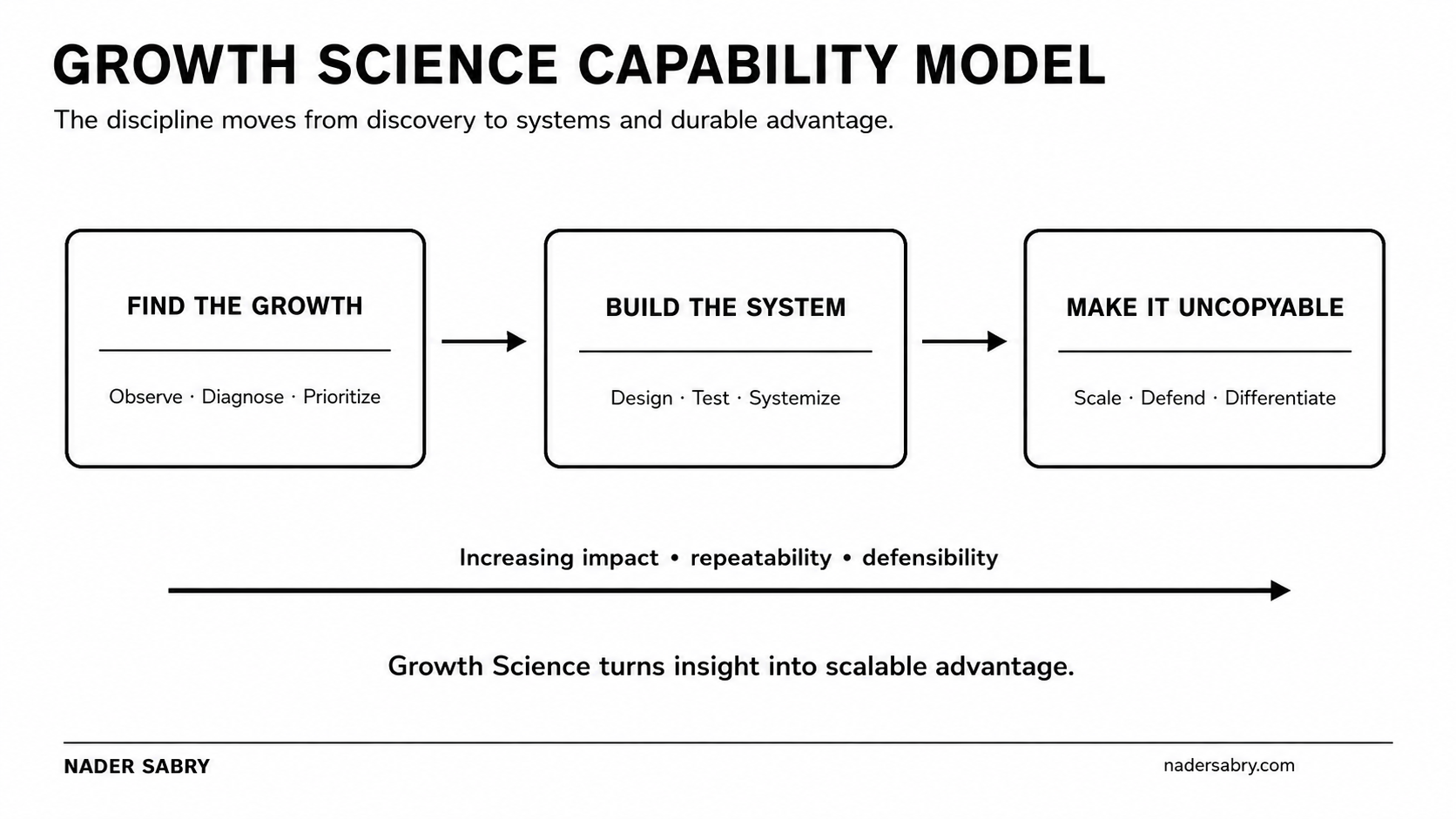
The Growth Scientist learns to observe, diagnose, prioritize, design, test, systemize, scale, defend and differentiate. Their central question becomes: How do we repeatedly find growth, build the system that captures it and create an advantage others struggle to reproduce?
The emphasis has therefore moved from discovery, through design, into repeatability and advantage. These are not three competing professions; I see them as a maturity path.
Growth Hacker → Growth Thinker → Growth Scientist
Ready, Set, Growth Hack explored leverage and disproportionate growth. Growth Thinking focused on turning growth ideas into structured action. Hire Me If You Can tackled the human capability required to build growth. Growth Science brings those layers together around a larger ambition:
Find the Growth. Build the System. Make It Uncopyable.
We now have the destination. The next question is practical: How do you build the capability to operate there?
The Growth Science Capability Model
Most people trying to become growth hackers eventually run into the same problem: their development plan becomes a shopping list. SEO. Analytics. Paid media. Automation. Experimentation. Product. Coding. Customer research. AI. The list keeps expanding because growth itself keeps touching more parts of the business.
Eventually the model breaks. No individual can become the deepest specialist in every discipline growth touches, and trying to do so often creates shallow capability across everything rather than meaningful capability anywhere. The answer is not to keep making the list longer. It is to organize the skills around the actual work of creating growth.
I would organize that work around three jobs: Find the Growth, Build the System and Make It Uncopyable.
1. Find the Growth
Finding growth begins with learning to see. That sounds simple, but most organizations are already surrounded by information: dashboards, reports, customer conversations, market signals and operational data. The problem is rarely that nothing is known. The problem is knowing what deserves attention.
Observe. Study customers, competitors, markets, behaviour, economics, technology and friction. Look for contradictions, bottlenecks, unusual behaviour, underused assets and changes that do not fit the existing explanation of the business. Curiosity is not an optional personality trait here; it is part of the discovery process.
But observation is only the beginning because a signal is not a cause. A business may see falling sales and conclude that demand has weakened. Perhaps. Or traffic may be stable while conversion has collapsed. Conversion may be healthy while repeat purchase has deteriorated. Retention may be excellent while acquisition has simply become too expensive. The headline problem may look the same, yet the underlying economics are completely different.
That is why diagnosis matters. The Growth Scientist has to separate symptom from cause before committing resources to a solution.
Once the probable cause becomes clearer, the next job is prioritization. Not every real problem deserves immediate action, and not every interesting opportunity can materially affect the business. A Growth Scientist should pressure-test an opportunity against several criteria:
Material — Will solving this materially change the growth objective?
Evidence — Is there enough evidence to believe the issue is real?
Testable — Can we investigate it credibly?
Feasible — Can the organization realistically intervene?
Scalable — If it works, can the result become meaningfully larger?
This distinction is becoming even more important because generating ideas is becoming cheap. AI can produce dozens of plausible growth ideas in minutes. Knowing which two could materially change the economics of the business is far more valuable than generating the other forty-eight.
Finding growth therefore follows a simple progression: Observe → Diagnose → Prioritize. Once the right opportunity has been identified, the nature of the work changes. Now something has to be built around it.
2. Build the System
Finding a good opportunity is a major step, but an opportunity is not a solution. This is where organizations often confuse insight with execution. Someone discovers something interesting, creates a presentation, assigns an owner and assumes the difficult part is over. Usually it is just beginning.
Design. Somebody still has to determine what could actually change the condition that was discovered. Suppose customer research shows that buyers are abandoning a product because they do not understand its value. The answer might be better marketing, but it could also be a simpler product, different onboarding, a new pricing structure, a different customer segment or a complete change in how the offer is packaged.
This is why a Growth Scientist cannot approach every problem carrying the same favorite tool. The solution has to follow the diagnosis.
Then comes testing. A good Growth Scientist does not protect an idea from being proven wrong; they want to know whether it survives evidence. The learning sequence is straightforward:
Hypothesis — What do we believe?
Experiment — How can we investigate it?
Measurement — What happened?
Learning — What does the evidence actually tell us?
Decision — What changes because of what we learned?
That final step is easy to underestimate. Experimentation can become theatre. Organizations proudly report how many tests they ran, but the more important question is: What did the business actually learn? A failed experiment that kills a dangerous assumption may be worth considerably more than ten successful tests that do not change a meaningful decision.
The objective is not more experimentation. The objective is better discovery.
When something works, the work is still not finished. A successful result immediately creates another question: How do we make this happen repeatedly?
This is where Booking.com provides a useful example. Harvard Business Review described a company running around 25,000 tests a year, but the important lesson was not the sheer number of experiments. Experimentation had been embedded into the company's culture, infrastructure and decision-making rather than treated as an occasional innovation project. Harvard Business Review
That distinction is crucial. The Bing example shows evidence revealing leverage. Booking.com shows what happens when experimentation becomes organizational capability.
A growth hack produces an outcome. A growth system makes the capability repeatable.
Systemization may translate a successful insight into data signals, rules, technology, process, training and ownership. Once successful discoveries can be reproduced, measurement becomes consistent and the capability survives beyond the person or experiment that originally created it.
At that point the organization is no longer simply running a growth hack. It is building a growth system.
3. Make It Uncopyable
A result that works once is not automatically scalable, and something scalable is not automatically defensible. Those are separate problems.
Scale. Ask whether the result survives when conditions change. Can it work with ten times the number of customers? Can it operate across markets? Can fifty employees reproduce something one founder did intuitively? Does it still work when competitors respond? Scaling forces the Growth Scientist to understand which parts of the success were fundamental and which were accidental.
Then comes defense. Successful ideas attract imitation. Competitors can copy a campaign, match a feature, lower a price or hire your people. Visible tactics are usually the easiest part to reproduce. Systems are harder.
Defensibility may emerge from combinations of:
Proprietary data
Distribution
Customer relationships
Economics
Technology
Talent
Process
Partnerships
Brand
Trust
One element alone may not be particularly difficult to copy, but several reinforcing one another can be. This is where differentiation becomes more than marketing positioning. The objective is to build enough capability around a successful growth mechanism that the system itself becomes part of the advantage.
That is the larger Growth Science journey: Find the Growth → Build the System → Make It Uncopyable. Once the work is defined this way, the skills question becomes much easier to answer.
What Skills Does a Growth Scientist Actually Need?
Traditional growth-hacker skills lists became enormous for a reason. The role kept expanding into SEO, analytics, coding, paid media, CRO, UX, copywriting, email, automation, product, sales, finance and now AI. At some point, though, you have to admit the obvious: nobody is going to be exceptional at everything, nor should they try to be.
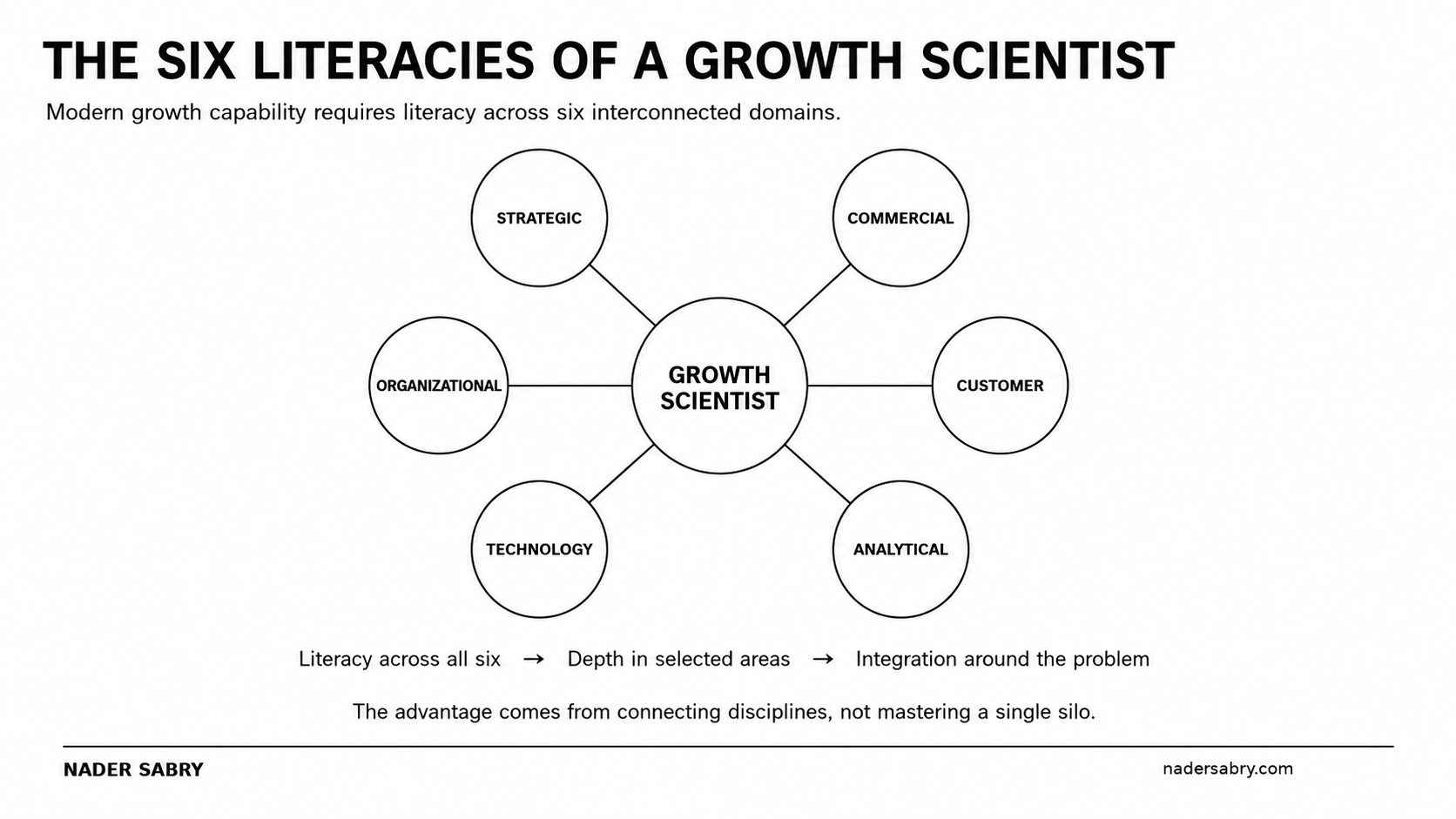
A stronger model is to build literacy across six interconnected areas, develop genuine depth in selected areas and learn to integrate them around a growth problem. The goal is not mastery of all six. It is enough understanding across each area that you can see how they interact and know when deeper expertise is required.
The Six Literacies of a Growth Scientist
Strategic literacy — Understand objectives, choices, positioning, priorities, competitive advantage and trade-offs. Growth without strategic direction can become very efficient activity aimed at the wrong outcome.
Commercial literacy — Understand revenue, pricing, margins, conversion, retention, customer economics and business models. A metric moving upward is not automatically good growth.
Customer literacy — Understand behaviour, psychology, needs, journeys, friction and perceived value. Data can tell you what happened; customers often help explain why.
Analytical literacy — Understand measurement, hypotheses, experimentation, causality and evidence. Data should sharpen judgment rather than replace it.
Technology literacy — Understand what AI, automation and digital technologies make possible, even when you are not personally engineering every component.
Organizational literacy — Understand people, incentives, ownership, collaboration and execution. A brilliant growth idea has little value if the organization cannot act on it.
Your specialization may sit deeply inside one or two of these areas. That is good. Depth matters. But the real growth capability comes from connecting those areas around the same problem.
That leads naturally to one of the oldest models for describing growth talent: the T-shaped professional. I still think it is useful, but I no longer think it is the whole model.
Why T-Shaped Skills Are No Longer the Whole Model
The T-shaped model solved a genuine problem. Nobody can master every discipline, so it encouraged professionals to develop broad familiarity across many areas while going deep in one or two. That remains sensible.
What is changing is the economics of the horizontal part of the T. A strategist can now prototype. A marketer can analyze data. An analyst can generate campaign concepts. A product manager can produce useful code. A founder can create a functioning interface without first assembling an entire development team.
That does not mean expertise becomes less important. In many cases it becomes more important because deep expertise helps you recognize when an AI-generated response is insightful, superficial or simply wrong. What becomes less scarce is access to capabilities that previously required another specialist.
And when access becomes easier, integration becomes more valuable. Can you connect customer behaviour with economics? Product with technology? Data with strategy? A promising experiment with the people and processes required to scale it?
I would therefore describe the modern capability stack as:
Depth — genuine expertise somewhere.
Breadth — literacy across adjacent disciplines.
Integration — the ability to connect those disciplines around a problem.
Judgment — knowing what matters and what should happen next.
Of those four, judgment may increasingly become the most valuable. AI is one of the biggest reasons why.
AI Does Not Kill the Growth Hacker. It Raises the Bar.
Every significant technology shift changes what is scarce. The internet made distribution cheaper. Cloud computing made infrastructure more accessible. No-code reduced some of the technical barriers to building software. AI is now making large amounts of cognitive execution faster and cheaper.
For anyone working in growth, this is a profound change. AI can assist with market research, data analysis, customer segmentation, coding, campaign concepts, prototypes, automation, scenario modelling, hypothesis generation and the synthesis of customer feedback. A practitioner can move from idea to initial evidence at a speed that would have required several people only a few years ago.
The World Economic Forum's skills research is useful here because it shows both sides of the change. AI and big data are among the fastest-growing skill categories, yet analytical thinking remains a leading core skill, while creative thinking, curiosity and lifelong learning continue to grow in importance. World Economic Forum
This suggests that technical capability and human judgment should not be treated as substitutes. They increasingly reinforce one another.
If competitors have access to similar AI capabilities, the tool itself becomes less differentiating. The difficult questions move upstream: What should we investigate? What is actually causing the constraint? Which signal matters? Which opportunity deserves attention? What should we test first? Did the evidence prove what we think it proved? Did the result create meaningful economic value? Can it become a repeatable system? Can competitors reproduce it easily?
AI dramatically increases execution capacity. That makes the quality of human judgment more consequential, not less.
So yes, learn AI aggressively. Use it. Understand what it makes possible. But do not organize your entire career around becoming better at tasks AI will continue making cheaper. Build the capabilities that determine which work should be done, why it matters and what the evidence means.
That changes the way you should learn growth in the first place.
Build a Learning System, Not a Reading List
For years, aspiring growth hackers have asked versions of the same questions: What are the best growth hacking books? Which course should I take? Which tools should I learn? Which experts should I follow?
I have written about all of those things, and they are useful questions. But looking back across that body of work, I think the deeper principle is this:
Information is not capability. Application is the conversion mechanism.
Reading ten books does not make you a growth hacker. Completing five courses does not make you one. Following fifty practitioners does not make you one, and knowing twenty software platforms certainly does not make you one. All of those things can accelerate development, but capability appears when knowledge gets put under pressure.
Growth is contextual. A tactic that creates extraordinary results in one company may produce nothing in another because the customers, economics, product, technology, timing and constraints are different. The objective of learning should therefore not be to collect somebody else's answers. It should be to improve the quality of your own questions.
A strong learning system has six parts. Study across disciplines rather than living inside one growth bubble. Strategy, marketing, economics, psychology, product, finance, technology and operations can all improve how you understand growth. Train when structured learning gives you methodology, deliberate practice, feedback and application. Before choosing a course, ask, What will I actually be able to do afterward that I cannot do today?
Then practice on real problems — your employer, a startup, a nonprofit, a side project or your own company — anywhere the outcome can actually be observed. Measure by defining success before you act. Reflect on what you expected, what actually happened and what you missed. Then repeat.
Study → Train → Practice → Measure → Reflect → Repeat
Over time, knowledge becomes experience, and experience becomes judgment. That changes the measure of professional development. The important question is no longer how many books you have read or certificates you have earned. It is: How much better have you become at diagnosing, testing and solving real growth problems?
And if that is the measure, your most important career asset should not simply be a CV. It should be evidence.
Learn From Practitioners — But Do Not Copy Their Hacks
There is enormous value in studying people and organizations that have produced unusual growth, but most people study them incorrectly. They ask, What hack did they use? That is often the least transferable part of the story.
A tactic works inside a particular combination of customer behaviour, economics, technology, timing and market conditions. Remove the context and the same tactic may achieve absolutely nothing. A more useful approach is to study the reasoning behind the outcome.
Ask what they noticed, which assumption they challenged, which constraint they identified, why the intervention worked in that specific context, what evidence caused them to act and how they made the result repeatable.
Copying somebody else's hack teaches you a tactic. Understanding the reasoning teaches you how to think. That is much more valuable and consistent with the underlying argument of Ready, Set, Growth Hack: the goal is not to accumulate other people's tricks but to develop the capability to find disproportionate growth in your own context.
Once you begin learning that way, your experience becomes something you can document — which brings us to one of the most important practical assets a future Growth Scientist can build.
Build a Growth Portfolio, Not Just a CV
A CV tells me where you worked, the titles you held and perhaps some of the outcomes associated with those roles. That information is useful, but it does not necessarily tell me how you think.
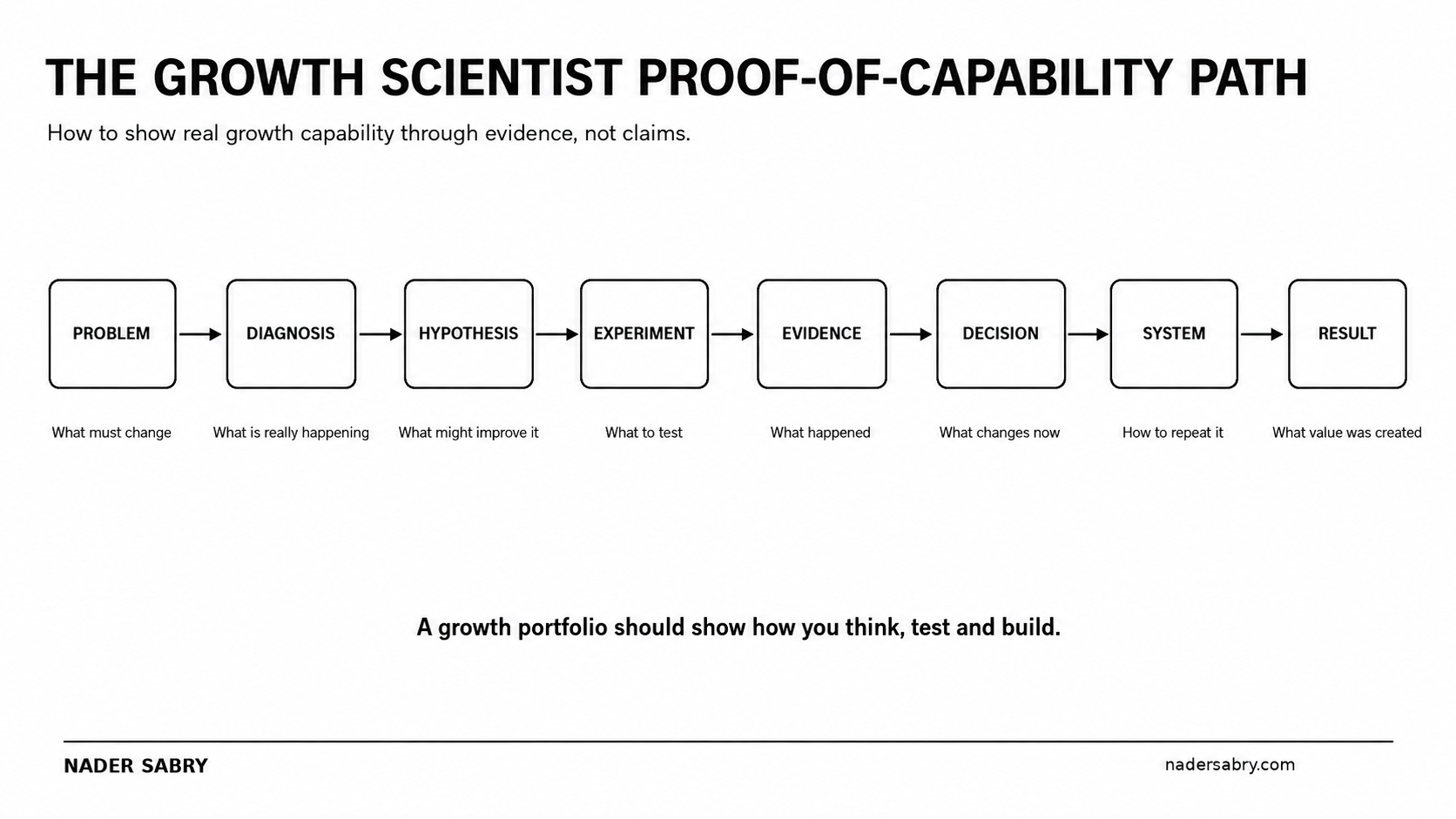
If you want an employer, founder or client to believe you can systematically create growth, build a growth portfolio that documents how you approach real problems.
Problem → Diagnosis → Hypothesis → Experiment → Evidence → Decision → System → Result
For every meaningful growth problem, document:
Problem — What outcome needed to change?
Diagnosis — What was actually happening?
Hypothesis — What did you believe could change the result?
Experiment — What did you test?
Evidence — What happened?
Decision — What changed because of the evidence?
System — How could the successful result be repeated?
Result — What measurable value was created?
This is how you begin proving growth capability. A list saying Google Analytics, HubSpot, Python, ChatGPT, SEO and A/B testing tells me which tools you have encountered. The portfolio tells me whether you know what to do with them.
A CV tells me where you worked. A growth portfolio shows me how you think.
This connects directly with the human-capability problem explored in Hire Me If You Can. A growth methodology is only as powerful as the people capable of applying it. Organizations therefore compete not only through products, capital and markets, but also through the quality of the people capable of finding, testing, building and operationalizing growth.
And because growth is increasingly cross-functional, that person does not have to start in one traditional profession.
You Do Not Need to Start in Marketing
One of the oldest assumptions about growth hacking is that the practitioner must begin as a digital marketer. I do not believe that is true anymore.
A future Growth Scientist could start in marketing, product, engineering, finance, analytics, sales, strategy, design, operations, customer experience or entrepreneurship. Every starting discipline creates both an advantage and a blind spot.
A marketer may understand demand deeply but need stronger economics. An analyst may understand evidence but need greater customer intuition. An engineer may understand what can be built but need deeper commercial awareness. A strategist may frame problems extremely well but need more experimentation and execution experience. A salesperson may understand customer behaviour better than almost anyone in the organization but need stronger analytical structure.
The answer is not to abandon your starting discipline. Use it as your first point of depth, then deliberately expand around it. That is how multidisciplinary growth capability develops.
And regardless of where you begin, there is another layer that influences everything else: mindset.
The Growth Mindset Still Matters
Technology changes quickly. Platforms change. Algorithms change. Tools change. Human decision-making changes much more slowly, which means many of the characteristics associated with strong growth practitioners remain surprisingly durable.
The original growth-hacker mindset was partly about challenging accepted rules, looking for unconventional solutions and finding leverage where others saw constraints. Those ideas still matter, but I would describe the modern Growth Scientist mindset more precisely.
A Growth Scientist needs curiosity because discovery begins when somebody notices something others have stopped questioning. They need the willingness to challenge assumptions, because the current system is what produced the current result. They need resourcefulness, searching for leverage before automatically adding more money, people or activity, and creativity, because many of the strongest growth opportunities sit between disciplines rather than neatly inside one of them.
They also need evidence over ego. An experiment must be allowed to prove the original idea wrong. Collaboration matters because modern growth crosses too many organizational boundaries for the mythology of the lone hacker to remain useful. Commerciality matters because traffic, users or even revenue are not automatically good growth if the economics deteriorate. And ethics matters because the ability to influence behaviour creates responsibility; a short-term metric produced by exploiting customers is not sustainable growth.
These are sometimes dismissed as soft skills. I think that understates them. They directly affect the quality of growth decisions, and decision quality is ultimately what separates knowledge from professional capability.
That raises the obvious question: when have you actually earned the right to call yourself a Growth Scientist?
When Can You Call Yourself a Growth Scientist?
Not because you completed a course, changed your LinkedIn title, mastered an AI platform or ran one experiment that happened to work. The stronger test is repeated evidence.
A Growth Scientist is not certified by knowledge. They are demonstrated by repeated evidence.
Can you repeatedly find a meaningful growth problem, distinguish cause from symptom, form a credible hypothesis, design a useful experiment, interpret evidence honestly, turn that evidence into decisions, connect multiple disciplines around the same problem, systemize what works and create measurable value?
That is a much harder standard, and it should be. The title itself is secondary. Capability is what matters.
As that capability develops, another shift happens. You become less obsessed with knowing everything and much better at knowing what deserves attention. That is where judgment begins separating competent practitioners from exceptional ones.
What Separates a Good Growth Practitioner From a Great One?
Eventually, the difference is not another tool. It is judgment.
Two people can look at exactly the same company. One sees an acquisition problem. The other realizes poor retention is making every additional acquisition less valuable. Two people can look at the same dataset. One sees falling conversion. The other discovers that almost the entire decline comes from one customer segment affected by a single onboarding change.
Two people can also use exactly the same AI model. One asks it to generate ten growth ideas. The other uses it to interrogate a carefully constructed hypothesis about a constraint nobody inside the organization has recognized.
Both practitioners have access to the same technology, but they ask different questions, notice different signals and arrive at different conclusions. Same technology, different judgment — and ultimately different results.
That is why I do not believe the future Growth Scientist is someone who knows everything. They are someone becoming progressively better at knowing:
What actually matters?
And that brings the argument back to where we started.
What This Means for Your Career
If you entered this article asking how to become a growth hacker, the answer is probably broader than you expected. Yes, learn analytics. Learn experimentation. Understand customers. Develop commercial literacy. Build technical capability. Use AI aggressively. Read good books. Take useful courses. Find mentors and study practitioners.
But do not confuse those inputs with the profession itself.
Your development is ultimately measured by whether you can see what others miss, diagnose what actually matters, prioritize the right opportunity, design a credible intervention, test it against evidence, turn what works into a system, scale that system and strengthen it until it creates advantage.
That is why I increasingly see the destination not merely as becoming a better Growth Hacker. It is becoming a Growth Scientist.
Growth Hacking taught us to search for leverage. Growth Thinking helped turn that opportunity into designed action. Hire Me If You Can addressed the people capable of building and executing growth. Growth Science takes the progression further by asking how all of those capabilities can become a repeatable discipline.
Find the Growth. Build the System. Make It Uncopyable.
The final step is not theoretical. It starts with something very practical.
Start With One Growth Problem
Looking at the entire discipline at once can make it feel enormous, so do not start there. Do not begin by buying another tool, trying to learn everything or changing your job title.
Start with one meaningful growth problem.
Observe what is happening and diagnose the real cause. Prioritize what matters, design an intervention and test it against evidence. Measure what happened, learn from the result and ask whether what worked can be systemized. If it can, scale it. If it scales, start asking what would make the resulting capability difficult to reproduce.
Then do it again. And again.
Eventually something important changes. You stop merely knowing about growth and begin developing the capability to systematically create it.
AI will keep making execution easier. More people will be able to analyze, build, automate and experiment. That is good news because it lowers the barrier to participating in growth, but it also moves the barrier to being exceptional.
The value moves into what you see, what you choose, what you test, what you learn and what you build around the result. The tools will continue changing, but that is exactly why the underlying discipline matters.
The tools will keep changing. The discipline is learning how to create growth despite that change.
That is the journey:
Growth Hacker → Growth Thinker → Growth Scientist
Find the Growth. Build the System. Make It Uncopyable.
If you want to apply this thinking directly to commercial growth, More Revenue, Please takes the same philosophy into practical revenue action — identifying, unlocking and protecting value that may already exist inside a business.
More Revenue, Please on Amazon
Sources
Microsoft/Bing experimentation case — Harvard Business Review — 2017 — https://hbr.org/2017/09/the-surprising-power-of-online-experiments
Building a Culture of Experimentation — Harvard Business Review — 2020 — https://hbr.org/2020/03/building-a-culture-of-experimentation
Future of Jobs Report 2025 — World Economic Forum — 2025 — https://www.weforum.org/publications/the-future-of-jobs-report-2025/digest/